


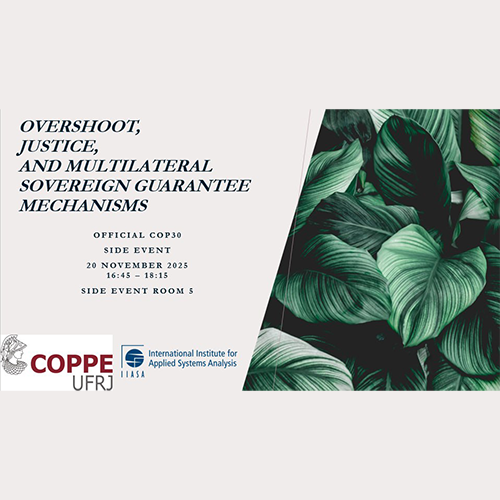
The Centro Clima Institute at COPPE/UFRJ, in partnership with CIRED and TERI, prepared for the COP30 side event, which was scheduled to take place on November 20th (but which was not held due to the fire that occurred), the presentation of a Pilot Initiative Proposal aimed at expanding climate finance and supporting developing countries in implementing pathways compatible with the Paris Agreement. Although the debate did not take place, the material produced for the panel was made available, including the Summary Statement, a document that synthesizes the main points of the proposal.
The text discusses ways to expand the use of multi-sovereign public guarantees, which are considered fundamental for mobilizing large volumes of private capital and reducing risks that still hinder green investments. Currently, many countries face fiscal limitations because they are required to fully register the guaranteed amount as a liability, which increases the cost of using these guarantees and reduces their attractiveness.
To address this challenge, the initiative proposes the creation of Multi-Sovereign Guarantee Mechanisms (MSGMs), which would allow participating countries, including several developed countries, to jointly provide high-level sovereign guarantees (AAA+). This shared model reduces costs, increases investor confidence, and enables more accessible and long-term loans for climate projects in the Global South. The MSGMs would bring benefits both to developing countries, by expanding fiscal space and attracting investments, and to guaranteeing countries, which would gain new opportunities for secure investment and reinforce their international legitimacy.
The proposal recommends that the platform be flexible, capable of supporting different transition pathways and collaborating with development finance institutions, strengthening local initiatives. As a next step, it is suggested that COP30 establishes a "design lab" to develop operational rules and test an experimental platform with pioneering countries.
The initiative is also supported by strategic contributions to international agendas. The text presented in 2024 within the scope of the T20, the G-20 think tank group, "Towards a multi-sovereign guarantee mechanism for low carbon investments and climate resilience in developing countries", reinforces the relevance of a multi-sovereign guarantee architecture (MSGA) for mobilizing private finance, reducing risks, facilitating capital flows, and supporting the fulfillment of NDCs in the context of the Paris Agreement. This architecture seeks to address regional and sectoral barriers, strengthen global value chains, and boost the reform of the multilateral financial structure.
The proposal was also submitted to the UNFCCC's Baku to Belém Roadmap to USD 1.3 Trillion, in the document “A Multi-Sovereign Guarantee Mechanism to Accelerate Climate Investments in Developing Countries”. The submission describes the multi-sovereign mechanism as a solution capable of accelerating climate investments by transforming sovereign guarantees into "non-debt" instruments, reducing capital costs and extending financing terms.
Two other studies, coordinated by CIRED, in Paris, and University College of London, respectively, complete the foundation of the Declaration presented at COP 30.
Access the full documents:
- Summary Statement
• Contribuição para o T20
• Submissão para o Baku to Belém Roadmap to USD 1.3 Trillion
• Versão preliminar – Securing the acceleration of climate action thanks to the short-term benefits of multi-sovereign climate finance
• Scaling Climate Finance in EMDEs Through Guarantees: Unlocking Private Capital for EMDEs in a Shifting Geopolitical Landscape
